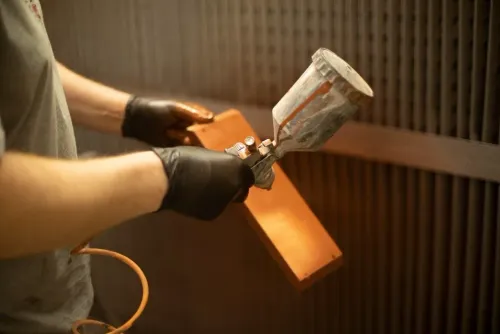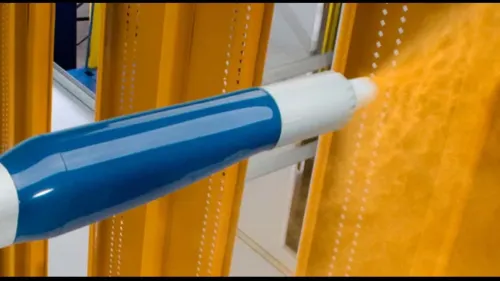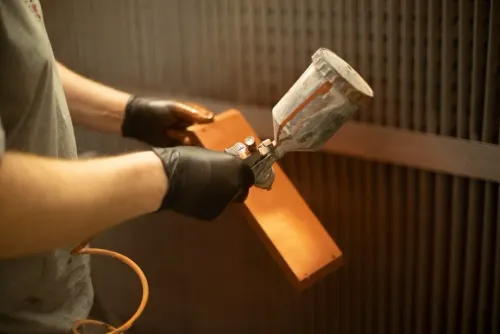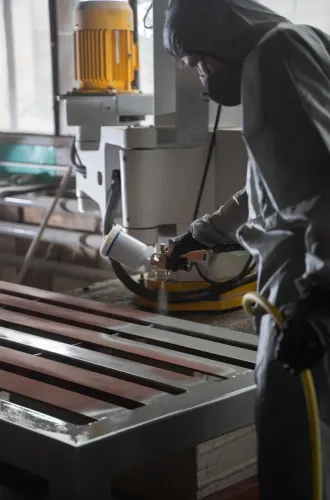
“Antique finish” does not identify one coating system: it could mean distressed wood grain, aged bronze, darkened edges, patinated metal or controlled tonal variation. You will be able to define the appearance, qualify it on the actual baffle profile, check production controls and compare a Mumbai coating service before approving the ceiling.
Key takeaways
- Define the antique effect with reference samples, not a colour name.
- Match coating and sublimation to the aluminium profile and exposure.
- Approve grain direction, coverage, colour and performance before installation.
- Use a representative production trial to assess a Mumbai coating service.
Define the antique appearance before requesting a quotation
“Antique” must describe a repeatable visual result, not merely a colour name. Decide whether your baffles should resemble distressed timber, aged bronze, patinated metal, darkened edges, or an intentionally uneven tonal surface. Wood-effect sublimation and solid metallic or patina-style finishes are different coating specifications.
For an antique finish coating for baffle ceiling in Mumbai, write the appearance brief in this order:
- Select a finish-card reference showing the exact base colour, grain or patina pattern, texture, and edge treatment.
- State the gloss range, such as matt, low-sheen, or satin, and identify whether mottling is fine, clouded, streaked, or directional.
- Define acceptable shade variation between baffles and within one baffle. State whether exposed cut ends, punched holes, mitres, hanger slots, and concealed faces must match the visible face.
- Attach a physical sample or approved side-by-side photograph viewed from the intended distance under the project’s lighting, including daylight and artificial light.
- Record what is unacceptable: bright bare aluminium, random dark patches, excessive grain contrast, pinholes, scratches, or a polished repair mark.
Do not approve a sample panel alone if the production baffles use another alloy, wall thickness, profile depth, or suspension arrangement. Those differences change the final appearance. A quotation for antique finish coating in Mumbai should also state whether the antique effect is expected to survive cleaning and how visible installed repairs may be.
Match the finish to the aluminium profile, exposure and accessories
Approve the finish against a representative baffle assembly, not a flat sample panel. For a wood grain powder coating baffle ceiling, qualify the aluminium alloy, wall thickness, profile depth, perforations, end caps, suspension parts and accessories with the compatible base powder, transfer film and sublimation heating cycle as one system.
Changing one component can alter heat-up, masking, electrostatic coverage or grain transfer.
Require the trial and site review to cover:
- Visible and concealed profile faces, including shadowed areas
- Cut ends, punched holes, mitres, welds and hanger slots
- End caps, clips, suspension components and any exposed fasteners
- Bare aluminium at cut edges, with the specification stating whether it is acceptable and how it will be protected
- The intended grain direction, profile spacing and assembly layout
- Exposure near open façades, sea-facing openings, cooling towers, humid plant rooms or polluted traffic air
Select the corrosion category from the actual Mumbai exposure, not simply from the ceiling being indoors. Use ISO 12944 atmospheric corrosivity guidance to agree the pretreatment and coating system before production; moisture, salts and pollutants can reach a ceiling through ventilation or open façades.
Then inspect a production trial using the actual baffle length, alloy, profile, end conditions and hardware. If the finish works only on the broad face, it is not qualified for the complete assembly. Mixing batches later can also change grain scale, colour and gloss across the ceiling.
Specify the coating and sublimation sequence for baffles
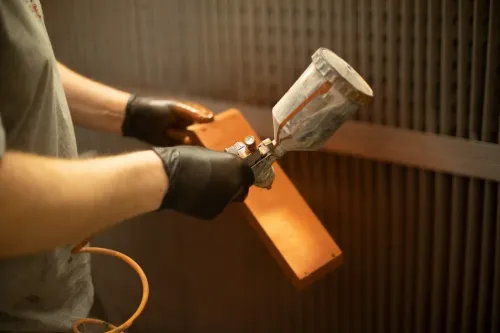
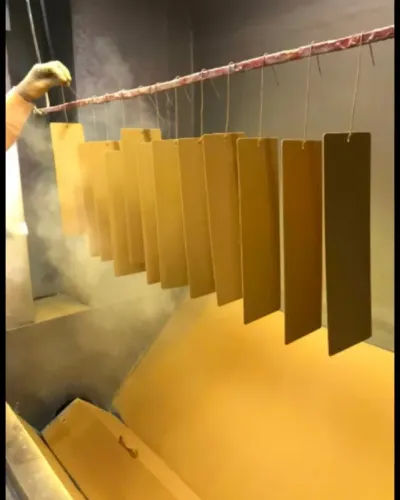
The supplier should document a qualified sequence, not simply call the result a wood finish. A wood grain powder coating baffle ceiling requires compatible aluminium preparation, base powder application and cure, followed by transfer-film sublimation as one approved system.
1. Record the aluminium alloy, profile identification, pretreatment chemistry, rinse stages, drying temperature and line speed. Inspect cut ends, punched holes, mitres, hanger slots, welds and concealed faces; state whether exposed aluminium at an edge is acceptable and how it will be protected.
2. Identify the powder manufacturer, product code, colour, batch number and specified dry-film thickness range. Measure film thickness on broad faces and difficult edges separately, and record substrate temperature, oven temperature, time at metal temperature and cure result against the powder supplier’s technical data.
3. Wrap the cured profiles with the approved printed film, recording film code, grain direction, overlap, contact pressure, sublimation temperature, dwell time and heating method. Use the qualified transfer cycle; excessive powder thickness can blur grain detail, while insufficient coverage leaves weak edges and poorer corrosion protection.
4. Define loading orientation and keep each approved profile, film batch and colour batch traceable. The baffle ceiling coating service in Mumbai should photograph the intended assembly layout and inspect colour, gloss, grain scale, mottling and coverage on faces, ends and slots after stripping the film.
5. Retain cure records, thickness readings, inspection photographs and the approved control sample. State that factory finish repairs require a compatible liquid coating or replacement, because site touch-up will not reproduce an antique pattern exactly.
Approve colour, grain, coverage and performance before installation
Approve a control sample before releasing any baffle for manufacture. Record the reference panel’s colour, grain direction and scale, mottling or patina pattern, texture, gloss range, acceptable shade difference, viewing distance and lighting. A colour name alone cannot expose batch drift in an antique finish coating in Mumbai.
1. Request coated samples from every proposed batch, then compare them side by side with the signed control panel. Check colour, gloss and grain under the intended interior lighting and daylight; do not approve from photographs alone.
2. Require a production trial using the actual alloy, wall thickness, profile depth, baffle length, end conditions and suspension hardware. Load every piece in the specified grain orientation. Mixing profiles or batches can produce different grain scale and tone across one ceiling.
3. Inspect faces, edges, grooves, perforations, cut ends and areas near attachments for thin or missed coating. Ask for dry-film-thickness readings, cure records and adhesion results against the agreed acceptance limits; a visually attractive face does not prove complete coverage.
4. Match the performance evidence to the exposure. Confirm whether the system meets AAMA 2603, 2604 or 2605, then agree the pretreatment and ISO 12944 corrosivity category for façades, cooling towers, sea-facing openings, plant rooms or polluted air.
5. Approve replacement and repair visibility in writing. Powder coating cannot be recreated exactly on site, and a mismatched touch-up is conspicuous on mottled finishes. Hold shipment until failed samples are corrected and rechecked.
Choose a Mumbai coating service using a representative production trial
Do not approve a production order from a decorative sample alone. Ask the baffle ceiling coating service in Mumbai to coat a trial using the actual aluminium alloy, wall thickness, profile depth, baffle length, perforations, end conditions, hanger slots and suspension hardware. These details change heating rate, masking, electrostatic coverage and transfer behaviour.
| Evidence | What it proves | Reject it when |
|---|---|---|
| Sample panel | Basic colour, grain and gloss direction | It uses a different profile or only shows a flat face |
| Representative production trial | Coating coverage, mottling, edge appearance and fit on your assembly | Cut ends, holes, concealed faces or accessories are missing |
| Trial records | Repeatability through pretreatment, powder application, curing and sublimation | The supplier gives no batch, film-thickness or oven records |
Specify acceptance before the trial. For an antique finish coating for baffle ceiling in Mumbai, provide the reference panel, colour, gloss range, texture, patina pattern, allowable shade variation, viewing distance and lighting. A colour name alone cannot settle a rejection.
Ask the supplier to show:
- Cut ends, punched holes, mitres, welds, hanger slots and concealed faces at close and normal viewing distances.
- Dry-film thickness, cure schedule, pretreatment details and batch identification.
- Cleaning and repair results on a concealed area using the proposed maintenance method.
- Exposure suitability for the actual site, including sea-facing openings, humid plant rooms or polluted air.
AMECO World of Coatings should be judged by this same representative trial, not by a catalogue image or a general wood-effect claim.
Related product
 | Wood Grain Powder Coating Wood Grain Powder Coating on Baffle Ceiling ₹60 We believe nature is supreme! Our high fidelity coatings of wooden patterns & figures on metal surfaces stand testimony to our belief. View product → |
Frequently asked questions
What should “antique” mean on a baffle ceiling quotation?
State whether you want distressed timber, aged bronze, patinated metal, darkened edges or an intentionally uneven tonal surface, then attach an approved reference sample.
How do you match an antique coating to aluminium baffles?
Check the aluminium alloy, profile shape, visible faces, installation exposure and accessories so the coating system suits every exposed component.
What coating sequence is used for wood-effect baffle ceilings?
Confirm the pretreatment, base powder coat, curing conditions, sublimation film or transfer stage, and any protective topcoat before production begins.
What must you approve before installing coated baffles?
Approve colour, grain direction, surface coverage, edge appearance, gloss, batch consistency and required performance using representative production samples.
How should you choose a baffle ceiling coating service in Mumbai?
Request a production trial using your actual aluminium profile, finish design, accessories and specified coating sequence before placing the full order.
Keywords