A wood-effect aluminium finish can lose colour, gloss or grain definition for very different reasons, from ultraviolet exposure and heat to poor pretreatment, under-cured powder and sublimation-film failure. You will be able to identify the failure mechanism, separate corrosion protection from colour retention, and specify the process controls and test evidence needed for a durable exterior finish.
Key takeaways
- Ultraviolet radiation breaks down dyes, pigments, and binders.
- Inspect orientation, exposure, defects, and cleaners before blaming colour alone.
- Use electro coating to strengthen the substrate’s protective barrier.
- Specify colour-retention tests, exposure conditions, and acceptance limits in writing.
What actually fades in a wood-effect metal finish?
A wood-effect metal finish does not fade for one reason: ultraviolet radiation breaks down sublimation dyes and pigments, while heat accelerates resin oxidation and colour change. Moisture, oxygen, atmospheric pollutants, and alkaline or solvent-based cleaning chemicals attack the binder or carry contaminants into defects.
Because the finish combines pretreatment, base powder, transferred image, and often a clear coat, failure in any layer can change its appearance. E-coat can improve corrosion protection underneath, but it does not automatically prevent UV damage.
- Unstable dye or pigment causes genuine loss of colour, especially in exposed grain tones.
- Resin degradation reduces gloss, weakens the clear coat, and can expose the printed image.
- Poor curing or intercoat adhesion allows moisture beneath the layers, causing blistering, peeling, or local colour loss.
- Heat and moisture can accelerate chalking, while pollutants and cleaners create surface deposits or stains.
| Defect | What you see | What it indicates |
|---|---|---|
| Overall fading | The whole finish becomes lighter or loses contrast | True dye or pigment degradation; this is metal finish colour fading |
| Gloss loss | The colour remains close, but the surface looks dull | Surface wear, resin oxidation, or early chalking |
| Yellowing | White or pale areas turn cream, amber, or brown | Binder oxidation, heat exposure, or contaminated clear coat |
| Chalking | A powder transfers to your finger or cloth | Binder breakdown, not automatically colour fade |
| Bleaching | Selected wood-grain tones wash out first | Local UV or heat sensitivity in the sublimation image |
| Staining | Irregular dark, yellow, or grey marks appear | Deposits, water runoff, cleaners, corrosion, or trapped contamination |
How sublimation creates colour and coating failure points
The wood pattern is not painted directly onto aluminium. A typical system uses a pretreated surface, a cured powder-coated base colour, a printed sublimation film, and often a clear powder topcoat.
The base powder provides the background and a smooth, sealed surface. The transfer film is wrapped around the part, then vacuum or pressure forces it against the coating while heat drives dye from the print into the powder film. Cooling fixes the image before the film is removed.
The result depends on every interface, not only the dye.
| Stage | What happens | Defect that can appear later |
|---|---|---|
| Pretreatment | Aluminium is cleaned, etched and conversion-coated | Poor adhesion, filiform corrosion or delamination |
| Base powder | Powder is applied and cured to a continuous film | Pinholes, craters, thin edges or colour mismatch |
| Film wrapping | Printed film must contact the profile uniformly | Blurred grain, bare areas, wrinkles or local shade variation |
| Transfer heating | Time and temperature drive dye into the coating | Weak colour, dye bleeding, distortion or incomplete transfer |
| Cooling and removal | The image stabilises and the film is peeled away | Scratches, lifting or trapped moisture |
| Clear coat | A compatible protective layer is applied and cured | Blistering, intercoat failure, gloss loss or accelerated fading |
Contamination, under-cure, over-cure and an unsuitable transfer cycle create wood effect powder coating defects that surface months later. An e-coat beneath the system can improve corrosion protection, but it cannot correct those failures or guarantee colour retention.
How to diagnose fading instead of guessing
Start by separating a surface change from a colour change: wood effect coating fading is not automatically dye or pigment fade. Compare the exposed face with a sheltered edge, underside or area behind a fitting, then record the difference before cleaning.
1. Wash a small area with pH-neutral detergent and dry it. A white-cloth wipe that picks up loose powder indicates chalking; the finish may look lighter because degraded binder and pigment residue are being removed.
2. Measure colour and gloss on cleaned and uncleaned areas. Persistent colour shift after wiping supports true dye or pigment fade, while a large gloss reduction with a smaller colour shift indicates gloss loss. Use the same instrument geometry and locations for comparison.
3. Inspect the colour pattern. Uniform change across the panel suggests weathering; bleached grain lines or a changed contrast between wood tones points to sublimation-dye instability or transfer-film failure.
4. Look for a yellow cast in the clear coat or base layer. Yellowing changes hue rather than simply reducing colour strength, and it can be confirmed by comparing colour coordinates with an unaffected sample.
5. Map isolated marks. A removable, sharply localised patch suggests staining from water, chemicals or deposits; bubbling, blistering, dark pinholes, white corrosion products or failure at cut edges and fasteners indicates corrosion-related failure.
A coating can show more than one mode. Record chalking, gloss, colour and corrosion separately instead of labelling every visible change metal finish colour fading.
What electro coating contributes to a wood-effect finish
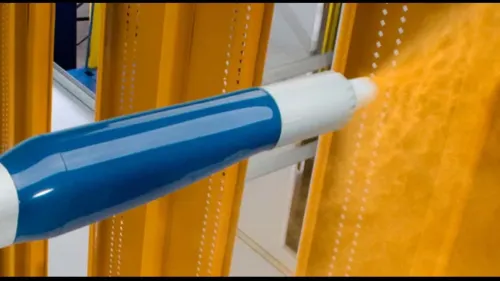
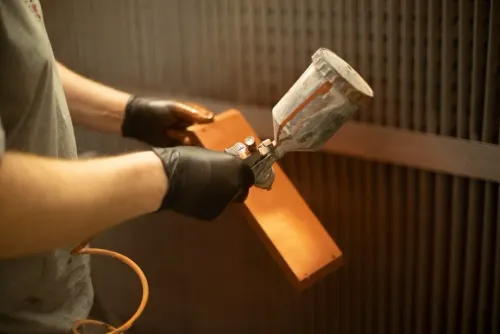
Electro coating means applying a coating by electrical charge, but the phrase covers two different processes. Electrophoretic e-coat immerses a conductive aluminium or steel part in waterborne resin and uses direct current to deposit the film. Electrostatic powder application charges dry powder, attracts it to the grounded part, and melts it in an oven.
| Process | What it contributes | Where it helps | Where it fails |
|---|---|---|---|
| Electrophoretic e-coat | A thin, continuous corrosion barrier | Recesses, edges and complex conductive shapes | It does not automatically stop ultraviolet fading, chalking or bleaching |
| Electrostatic powder application | The base colour, clear coat or other durable organic film | Building film thickness and creating the surface used for sublimation | Poor grounding, thin coverage or incorrect cure can cause adhesion and colour failure |
For electro coating wood effect metal, treat e-coat as a corrosion-control layer, not as proof of colour retention. Confirm resin compatibility between the e-coat, base powder, sublimation transfer and clear coat; incompatible layers can blister or delaminate even when the e-coat passes corrosion testing.
Electro coating for fading wood effect metal finish works only when the complete system is specified and tested. Record powder film thickness, metal temperature and dwell time, transfer temperature and time, and clear-coat cure. Oven air temperature alone cannot prove cure: under-cure weakens adhesion, while excessive heat can move sublimation dye or change the colour.
AMECO World of Coatings is relevant when you need one supplier to coordinate the powder, transfer and finishing stages rather than judging each layer separately.
Related products
 | Wood Effect on Metals Wood Effect Powder Coating on Aluminium Section ₹60 Ameco powder coating effect on metals is a safer and better alternative to conventional acrylic and polymer wet spray painting. View product → |
 | Coloral Wood Effect Finish Powder Coatings ₹60 We believe nature is supreme! Our high fidelity coatings of wooden patterns & figures on metal surfaces stand testimony to our belief. View product → |
How to specify and verify colour retention
Specify the complete finish, not a resin supplier’s generic weathering claim: pretreatment, base powder, sublimation dye and transfer, clear coat, and electro coating. For electro coating for fading wood effect metal finish, state whether “electro coating” means electrophoretic e-coat or electrostatic powder application; these processes are not interchangeable.
For a specification for electro coating wood effect metal, require:
- Pretreatment that names the conversion-coating chemistry, bath control limits, rinsing stages and corrosion-resistance test.
- Powder film thickness, oven metal-temperature profile and dwell time. Air temperature alone cannot prove cure; under-cure harms adhesion and chemical resistance, while excess heat can move dye or change colour.
- Transfer-paper contact, vacuum or pressure, transfer temperature and time, followed by controlled cooling and film removal.
- Clear-coat resin, thickness, cure profile, gloss retention and chalking limit. The clear coat must be UV-resistant; e-coat alone is not a colour-retention layer.
- Separate acceptance limits for colour change, gloss loss, chalking, adhesion, corrosion and intercoat compatibility. Passing corrosion testing does not prevent metal finish colour fading.
Use the intended architectural class as the verification target:
| Class | Use | Verification |
|---|---|---|
| AAMA 2603 | Lower exterior architectural exposure | Test the complete colour-and-coating system |
| AAMA 2604 | More demanding exterior exposure | Test colour, gloss, chalking and adhesion against the class |
| AAMA 2605 | Highest of these three levels | Require complete-system weathering evidence and acceptance results |
Record weathering exposure method, duration, colour difference, gloss change and chalk rating. Inspect cut edges and fastener interfaces separately; a sound surface can hide local failure.
Frequently asked questions
What causes wood-effect metal finishes to fade?
Ultraviolet radiation breaks down sublimation dyes and pigments. Heat accelerates resin oxidation and colour change, while moisture, oxygen, pollutants, and aggressive cleaners attack the binder or defects.
How does sublimation create failure points in a wood-effect finish?
Sublimation transfers dye from a printed film into a cured powder-coated surface under controlled heat and pressure. Poor curing, incomplete transfer, pinholes, weak adhesion, and damaged film leave paths for ultraviolet radiation and moisture.
How can you diagnose wood-effect coating fading?
Compare exposed and sheltered areas, record panel orientation, inspect gloss and surface defects, identify the coating and sublimation batches, and check cleaning chemicals before selecting a corrective action.
What does electro coating contribute to a wood-effect metal finish?
Electro coating creates a continuous, electrically deposited protective layer over prepared metal. It improves barrier protection and corrosion resistance beneath the decorative wood-effect system when pretreatment, curing, and layer compatibility are controlled.
How should you specify and verify colour retention?
Name the colour standard, exposure location, test method, gloss level, coating build, substrate preparation, and acceptance limits. Request batch records and compare retained test panels against the approved reference.
Related products
 | Ameco powder coating effect on metals is a safer and better alternative to conventional acrylic and polymer wet spray painting. View product → |
 | Wood Grain Powder Coating Wood Grain Powder Coating on Baffle Ceiling ₹60 We believe nature is supreme! Our high fidelity coatings of wooden patterns & figures on metal surfaces stand testimony to our belief. View product → |
 | Products as well as projects exposed to very harsh climatic and industrial conditions require extremely durable range of coatings. View product → |
 | Wood Finish Coating Sublimation Machine For Alumin Wood Finish Coating Sublimation Machine For Aluminium and Metal Doors Wood Finish Coating Sublimation Machine For Aluminium and Metal Doors View product → |
Keywords