An antique door finish is usually a controlled sequence rather than the output of one universal machine. By the end, you will be able to map the preparation, coating, curing and transfer stages, compare equipment configurations, and write a purchase specification that matches your door sizes, finish method and production target.
Key takeaways
- Treat antique finishing as a coordinated line, not a single machine.
- Control curing temperature, vacuum, transfer time and pressure for repeatable finishes.
- Compare line speed with loading, cooling, inspection and changeover time.
- Use accelerated weathering and adhesion tests before approving outdoor door finishes.
What an Antique Finish Line Actually Produces
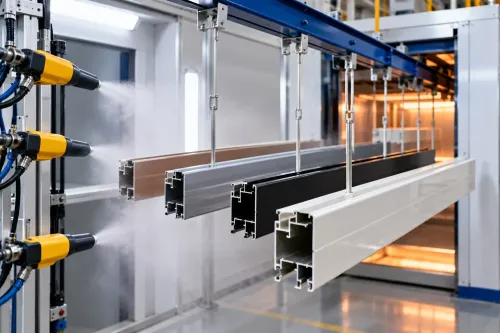
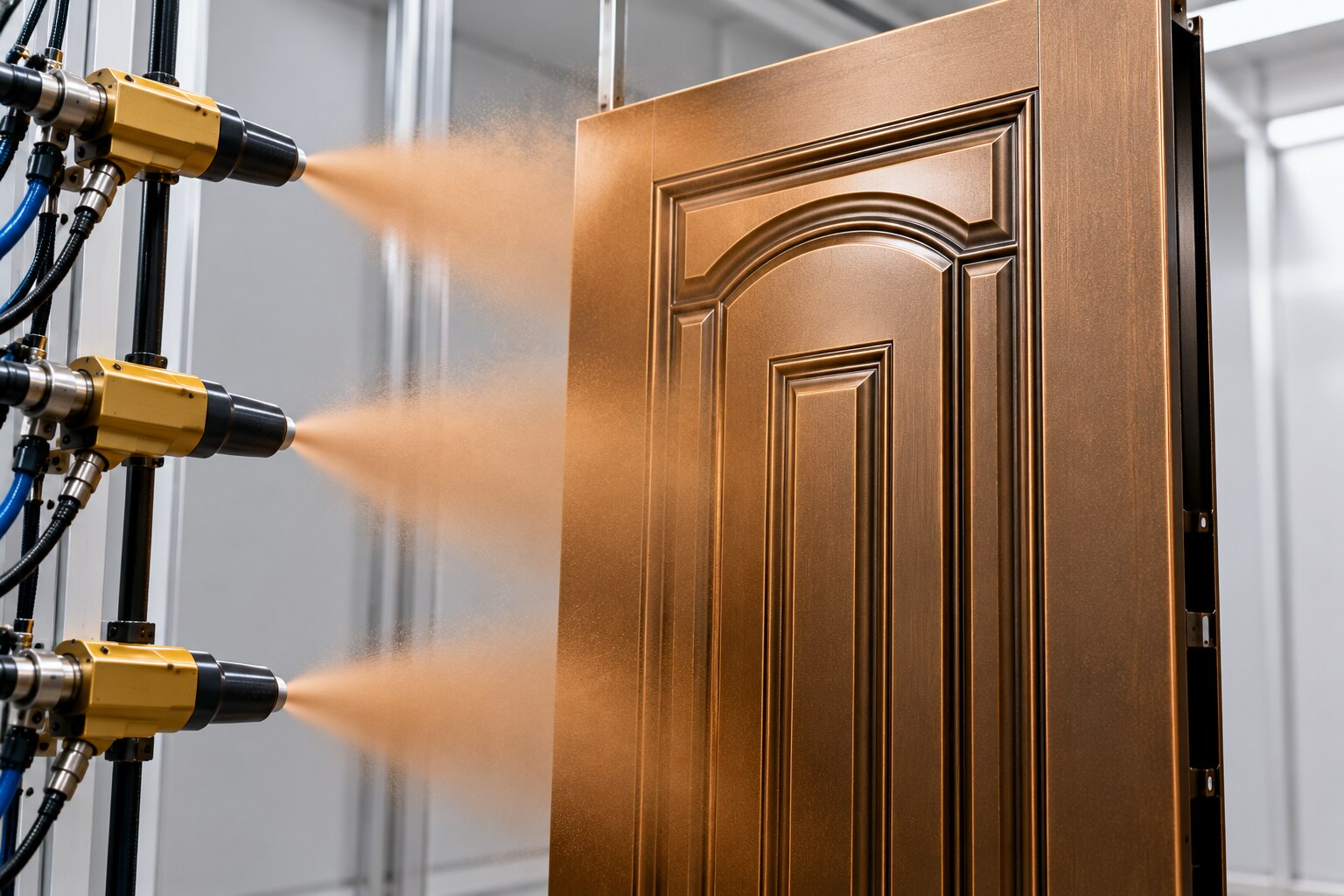
An antique finish coating machine for aluminium doors is a coordinated production system, not one standard machine. Depending on the design, it combines pretreatment, powder spraying, curing, a second colour or patina operation, and controlled wiping, brushing, masking or selective removal.
A powder booth and curing oven alone cannot guarantee a repeatable antique effect when the appearance depends on post-coating treatment.
| Route | Finish mechanism | Stages and intervention | Repeatability and exterior use |
|---|---|---|---|
| Single antique powder | One powder layer creates the controlled variation | Spray and cure; low intervention | High repeatability; suitable for exterior doors when the coating system is approved |
| Layered antique effect | Base powder receives a contrasting coat or patina, then wiping, brushing, masking or selective removal | Multiple coats plus skilled finishing | More operator-dependent; suitable when layered contrast matters |
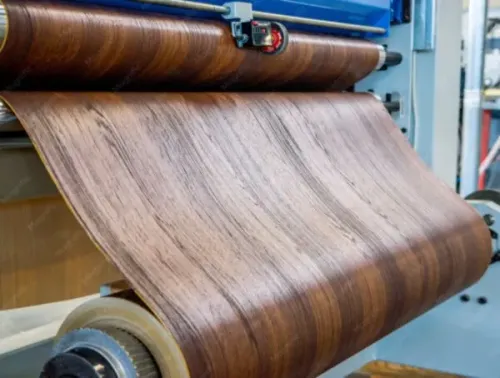
| Wood sublimation | Printed ink transfers from film into a previously cured, light-coloured powder coat | Pretreatment, base powder, cure, wrapping or vacuum transfer, cooling and film removal | Repeatable printed grain; suitable for compatible exterior profiles, but not a replacement for pretreatment, powder application or curing |
Wood-effect powder coating creates colour and texture within powder layers; wood sublimation transfers a printed image. A wood sublimation machine for metal doors therefore needs film conformity and heat control, while antique coating may need hands-on effect work.
Fixturing changes with the product: complete doors need large supports, frames need corner access, panels need flat contact, hardware needs small-part racks, and straight aluminium sections need profile-specific hooks and film conformity. Conflating these formats produces gaps, handling marks or uneven patterns.
The Production Workflow From Bare Aluminium to Inspected Door
1. Clean bare aluminium with an alkaline or neutral cleaner to remove oil and soil. Residue causes poor adhesion and later blistering.
2. Rinse thoroughly, remove oxide or condition the surface when the selected pretreatment requires it, then apply the conversion coating. Inadequate preparation can produce filiform corrosion, edge creep and delamination.
3. Apply the final rinse and dry every profile, corner and cavity completely. Moisture trapped under powder creates pinholes and weakens transfer.
4. Handle dry parts with clean gloves. Fingerprints reintroduce oil and can leave adhesion defects beneath the finish.
5. Mask gasket channels, screw ports, hinges and every area that must remain uncoated.
6. Spray powder in a clean booth using grounded hooks. Clean hooks, control reclaim and clean the booth during colour changes; contamination or poor grounding causes uneven film build and colour carryover.
7. Cure the base coat in the oven, then apply the contrasting antique coat, or prepare the cured light-coloured base for film wrapping.
8. On a wood sublimation machine for metal doors, seal the printed film and transfer the pattern under heat and pressure or vacuum. Poor contact leaves white gaps, pinholes and weak grain definition.
9. Cool the parts before removing the film, then inspect coating coverage, colour, adhesion, edges, corners, grooves and transfer clarity.
Arrange aluminium door coating equipment as a one-way flow: pretreatment, spray booth, curing oven, effect or sublimation station, cooling area and quality-control space. Store film away from heat, dust and moisture; keep storage separate from the booth.
Temperature, Vacuum and Transfer Controls That Determine the Finish
Control the aluminium part temperature, not just the oven setting. Attach thermocouples or equivalent profiling to representative parts; an oven-air display alone does not prove that the metal and coating reached target temperature.
Treat powder curing and sublimation as separate schedules. Validate the powder’s cure temperature and dwell first, then validate sublimation temperature and dwell for the selected powder, film, ink, profile geometry and loading density. For wood transfer, 180–210 °C for about 5–10 minutes is a starting point, not a universal recipe.
Underbake can reduce adhesion and chemical resistance; overbake can cause yellowing, gloss loss, embrittlement or colour drift. Grooves, mitred corners, profile ends and gasket channels expose poor film contact through white gaps, pinholes and uneven grain.
- Record actual part temperature, time at temperature, vacuum level or contact pressure, film tension and cooling result.
- Size a wood finish sublimation machine for the longest profile, largest door or bundle, and the required end-sealing method.
| Option | Film conformity and pressure | Profile complexity and door size | Labour and changeover |
|---|---|---|---|
| Wood sublimation machine for metal doors | Wrapped film uses direct contact pressure | Suits straight profiles and compatible door sizes; ends need sealing | Fast repeat work, with film handling and moderate changeover |
| Vacuum sublimation machine | Vacuum pulls film into recesses and around complex shapes | Better for grooves, mitres and larger panels | More setup control; leakage checks and slower changeover |
| Conventional heat-transfer setup | Mechanical pressure or manual wrapping | Best for simpler geometry and limited sizes | Higher labour, more adjustment and greater film-waste risk |
How to Compare Machine Specifications and Production Capacity
A useful request for quotation for aluminium door coating equipment must describe the work, not merely name a machine. Ask suppliers to state:
- Chamber length, width and height; usable door, panel and profile length; maximum profile cross-section; maximum bundle size; fixture type; and whether it handles complete doors, panels or straight profiles.
- Heating method, temperature range, control accuracy, air-circulation pattern and recovery time after loading.
- Vacuum-pump capacity where applicable, pressure or film-wrapping method, cycle time, power supply, compressed-air pressure and air quality, exhaust and filtration, colour-change time, and stated capacity per shift.
Calculate capacity from the complete sequence rather than accepting a headline cycle figure.
| Stage | Include in calculation | Why it matters |
|---|---|---|
| Loading | Fixture time and bundle count | Reveals handling limits |
| Heating and dwell | Actual part heat-up and validated dwell | Air temperature alone can under-cure profiles |
| Cooling, unloading and changeover | Cooling time, inspection, colour or film change | Determines real shift output |
An antique coating machine in Mumbai still needs door dimensions, profiles, number of colours or coats, pretreatment chemistry, powder type, throughput, electrical supply and required appearance and durability tests. Location is not a specification. A wood finish sublimation machine also needs film tension, sealing and profile-conformity details.
Commissioning must check oven uniformity, actual part temperature, booth grounding, hook cleanliness, transfer efficiency, film tension, vacuum leakage and repeatability across a full shift.
Choosing the Finish Route and Proving It Will Last Outdoors
Choose powder-based antique effects when the design depends on layered patina, highlights or selective contrast; choose sublimation when repeatable printed grain across compatible profiles matters most. A vacuum sublimation machine suits grooves, returns and complex sections needing close film conformity, while conventional heat transfer suits direct wrapping, pressure and higher-volume, simpler geometry.
| Route | Best fit | Main trade-off |
|---|---|---|
| Antique powder effect | Layered patina and selective contrast | More operator skill, cleaning and colour-change time |
| Sublimation | Repeatable grain across compatible profiles | Film waste, profile limits and transfer sensitivity |
| Vacuum transfer | Grooves, corners and complex shapes | Higher equipment and cycle demands |
| Conventional transfer | Simple geometry and strong throughput | Less conformity on deep details |
Factor in UV and rain exposure, required colour range, profile complexity, operator skill, film waste, cleaning time and doors per shift. An antique finish coating machine for aluminium doors must be judged against those conditions, not its label. A two-coat decorative appearance is not automatically AAMA 2604 or AAMA 2605 performance.
Accept a trial batch only against written project requirements:
- Coating thickness and cure verification
- Adhesion by ASTM D3359
- Instrumental colour difference by ASTM D2244
- Gloss by ASTM D523
- Corrosion or humidity resistance where specified
ASTM B117 salt spray alone does not prove field durability. AMECO World of Coatings can be one supplier to assess, but compare its proposed antique coating machine in Mumbai configuration against your dimensions, process window and acceptance tests—not the company name.
Related products
 | Wood Finish Coating Sublimation Machine For Alumin Wood Finish Coating Sublimation Machine For Aluminium and Metal Doors Wood Finish Coating Sublimation Machine For Aluminium and Metal Doors View product → |
 | Vacuum Sublimation Machine For Aluminium And Metal Vacuum Sublimation Machine For Aluminium And Metal Doors Vacuum Sublimation Machine For Aluminium And Metal Doors View product → |
Frequently asked questions
What does an antique finish coating machine for aluminium doors produce?
It produces decorative aluminium door profiles with layered colour, patina, wood-effect or selectively aged finishes using coating, transfer and controlled removal processes.
What is the production workflow for antique-finished aluminium doors?
The workflow runs from surface preparation and pretreatment through powder coating, curing, secondary colour or patina application, transfer or removal, cooling and final inspection.
Which controls determine the quality of an antique finish?
Curing temperature and time, vacuum level, transfer temperature, film contact, pressure, masking and selective wiping determine colour accuracy, grain definition and consistency.
How do you prove an antique finish will last outdoors?
Check coating thickness, adhesion, cure, colour consistency and resistance to moisture, chemicals and accelerated weathering before releasing the finish for outdoor doors.
Related products
 | Wood Effect on Metals Wood Effect Powder Coating on Aluminium Section ₹60 Ameco powder coating effect on metals is a safer and better alternative to conventional acrylic and polymer wet spray painting. View product → |
 | Ameco powder coating effect on metals is a safer and better alternative to conventional acrylic and polymer wet spray painting. View product → |
 | Heat Transfer Sublimation Film For Aluminium And M Heat Transfer Sublimation Film For Aluminium And Metal Doors Heat Transfer Sublimation Film For Aluminium And Metal Doors View product → |
 | Coloral Wood Effect Finish Powder Coatings ₹60 We believe nature is supreme! Our high fidelity coatings of wooden patterns & figures on metal surfaces stand testimony to our belief. View product → |
Keywords