Door manufacturers choosing between wood-effect sublimation and special anodizing are comparing two different surface technologies, not two versions of the same finish. The right decision depends on the required appearance, exposure, door geometry, production volume, utilities, labour and evidence that the finished system meets its service demands.
Key takeaways
- Cost pretreatment, curing, film, labour, energy, rejects and wastewater—not just equipment.
- Choose sublimation for printed wood grain; choose SPL anodizing for an integral metallic finish.
- Specify heating, racks, transfer film and grain direction around your door profile dimensions.
- Demand test results for adhesion, weathering, abrasion and colour retention before ordering.
Choose by finish, volume and complete process cost
A wood-effect sublimation machine or SPL anodizing for door manufacturers makes sense only after you cost the complete route, not the headline equipment price. Include pretreatment, powder coating, curing, transfer film, inks, heating, racks, labour, energy, rejects, maintenance, wastewater and inspection.
| Route | Finish and production fit | Complete-cost pressure |
|---|---|---|
| Wood-effect sublimation | Printed grain, knots and multiple colours; best when design variety and premium wood appearance drive sales | Adds powder coating, film, ink, heating, vacuum or wrapping, handling and transfer-film waste |
| SPL anodizing | Integral aluminium-oxide surface with metallic, relatively restricted colours; best for repeatable architectural ranges and high throughput | Requires tanks, rectifiers, rinsing, sealing, chemical control, wastewater treatment and larger installation space |
Choose sublimation when customers order several wood patterns, matching profiles matter, or you need to change designs without changing anodizing chemistry. Budget for tighter control of base powder, cure, film contact, temperature and cooling; a wrong setting creates colour variation, blisters or rework.
Choose SPL anodizing when the range favours uniform metallic colours, the finish must remain an integral oxide layer, and steady volume can absorb dedicated tanks and chemical infrastructure. Compare aluminium door coating options against actual monthly metres, batch size, changeover time and reject cost—not just cycle time.
Before buying, request a route-level cost per finished door and confirm the approved powder-film system, anodizing thickness and sealing specification. For architectural work, check whether the quoted evidence covers the decorative process, rather than assuming a certified base powder certifies the sublimated finish.
What SPL anodizing means—and how it differs from sublimation
SPL is a supplier term, not a universally defined anodizing class. For SPL anodizing doors, require the supplier to name the electrolyte, anodic-film thickness, colouring method, sealing chemistry, aluminium alloy limits and appearance grade.
The route normally cleans and etches aluminium, forms a porous oxide electrolytically, colours that oxide where required, then seals the pores with hot water, steam or a nickel-salt process.
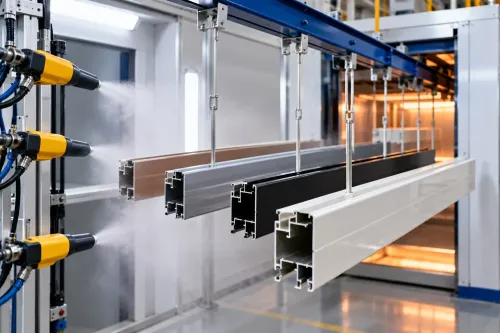
Sublimation is not anodizing. It applies a compatible powder base coat, cures it, then heats a printed film against the coating so dyes migrate into the polymer surface. The powder, film and cure schedule form one system; changing any one can alter colour, gloss, adhesion and weathering.
| Option | SPL anodizing | Wood-effect sublimation |
|---|---|---|
| Process chemistry | Electrolytic aluminium oxide; optional dye or electrolytic colour; sealed pores | Printed dyes infused into cured polymer powder |
| Colour and image | Clear, metallic or controlled anodic shades; limited grain and no repeatable photographic oak | Broad wood palette with grain direction, knots and repeatable printed patterns |
| Surface | Inorganic, metallic and close to the aluminium’s texture; alloy streaks or mottling remain visible | Polymer surface with selected gloss and texture; film contact or cure errors can create defects |
| Best expectation | Consistent architectural metal appearance after alloy and pretreatment control | Decorative wood appearance across profiles and panels |
Before approving an SPL quotation, follow this sequence:
1. Specify the alloy, oxide thickness, colour tolerance, sealing method and inspection standard.
2. Request test panels from the actual extrusion batch, including joints, cut ends and exposed faces.
3. Compare those panels with the complete sublimation system, not with an unspecified wood film. SPL anodizing doors suit metallic design; sublimation suits a printed wood effect.
Map the sublimation workflow to the machine specification
A wood finish sublimation machine must be specified around the complete route, not its chamber alone. Confirm pretreatment, compatible base powder, curing oven, transfer film, wrapping or vacuum station, heating, cooling, film removal and inspection before comparing quotations. Changing the powder, film or cure schedule can shift colour, gloss, adhesion and weathering performance.
Validate the production sequence in this order:
- Pretreat and powder-coat the aluminium, then verify cure by metal temperature rather than oven-air temperature.
- Apply the printed film, seal the profile or panel, and confirm contact around corners, grooves and thick sections.
- Heat until dyes migrate into the cured coating, then cool before removing film and inspecting colour, grain and pinholes.
| Stage | Specification to validate | Failure if missed |
|---|---|---|
| Base coating | Powder system, coating thickness, cure temperature and time | Poor adhesion, colour change or weak weathering |
| Loading | Maximum profile or panel size, chamber dimensions, rack positions and batch mass | Cold spots and uneven transfer |
| Heating | Heating method, temperature range, sensor locations and metal-temperature uniformity | Blurred grain or incomplete dye migration |
| Contact | Vacuum level, wrapping method, compressed-air pressure and film compatibility | Creases, air pockets and unprinted areas |
| Throughput | Cycle time, cooling time, electrical load and extraction requirements | Lower output than the quoted capacity |
Ask for trial data using your longest, thickest and heaviest planned load. Include film and ink supply, racks, maintenance access, wastewater and floor space when comparing wood effect coating machinery; a wood finish sublimation machine is only one part of the investment.
Match the finish to every door component and grain direction
Run profiles together only when they share the same alloy, base-coat colour, section thickness and grain specification. Mixing a heavy threshold with a thin sash can produce different heating and dye penetration, even in the same cycle.
| Component group | Finish together when | Main risk |
|---|---|---|
| Frame and sash profiles | Same extrusion lot, coating batch and grain direction | Shade or pattern mismatch at the meeting stile |
| Rails, stiles and glazing beads | Same profile family and film artwork | Film bridging leaves uncoated inner edges or corners |
| Panels and infill sheets | Same surface preparation and thermal mass | Wrinkles, trapped air or uneven contact across the panel |
| Thresholds and cut profiles | Only after a trial confirms heating and masking | Cut ends remain bare; sharp edges expose the base metal |
Uncoated edges arise where film cannot wrap tightly around a corner, where masking protects a gasket channel, or where a cut end is never covered. Burrs, oil, extrusion die lines and powder-thickness variation also print as dark streaks or voids. Inspect the first and last 100 mm of every profile, not just the visible face.
Control registration by creating a door-specific film layout with a fixed datum at the hinge end. Mark each profile’s orientation, keep the film repeat aligned to that datum, and use identical clamps or stops in the wood effect coating machinery.
Before production, assemble one complete door from trial-finished parts. Approve grain continuity across joints, then record film lot, profile batch, viewing direction and acceptable joint offset. These controls belong in your comparison of aluminium door coating options, including special anodizing, where colour matching still requires batch and orientation approval.
Demand system-specific durability evidence before placing the order
Do not approve either route until the supplier proves the complete finish system against your actual exposure, handling and cleaning routine. “Wood finish sublimation machine or SPL anodizing for door manufacturers” is not a durability specification; the base powder, transfer film, anodizing chemistry, sealing and substrate all affect the result.
| Route | Evidence to demand | Failure it can reveal |
|---|---|---|
| Wood-effect sublimation | System report covering EN 12206-1 and, where specified, GSB or Qualicoat; coating thickness, adhesion, cure, colour change and gloss retention after EN ISO 16474-3 exposure | A certified base powder does not prove that the decorative transfer system is certified |
| SPL anodizing | Anodizing thickness, sealing-quality result to ISO 2931 or the supplier’s stated method, colour uniformity and corrosion evidence to ISO 9227 | Poor sealing can produce staining, chalking or corrosion around scratches and cut edges |
| Either route | Product-specific cleaning test using your detergent, salt exposure for coastal sites, abrasion or handling test, and photographs before and after | A finish that survives weathering can still mark during installation or fail under alkaline cleaners |
Ask for the tested profile alloy, pretreatment, film or bath chemistry, cure or sealing schedule, test duration, acceptance limits and batch traceability. Request retained samples and test panels with mitres, drilled holes, cut edges and assembled joints. For SPL anodizing doors, ask how colour matching is controlled between production batches.
If AMECO World of Coatings is quoting the sublimation route, ask it to document the compatible powder, film, temperature window and vacuum-contact limits as one system, not as separate products. Reject any quotation that supplies only a generic “outdoor grade” claim.
Related products
 | Wood Finish Coating Sublimation Machine For Alumin Wood Finish Coating Sublimation Machine For Aluminium and Metal Doors Wood Finish Coating Sublimation Machine For Aluminium and Metal Doors View product → |
 | Vacuum Sublimation Machine For Aluminium And Metal Vacuum Sublimation Machine For Aluminium And Metal Doors Vacuum Sublimation Machine For Aluminium And Metal Doors View product → |
Frequently asked questions
How should door manufacturers compare a wood finish sublimation machine with SPL anodizing?
Compare the finish, production volume and complete process cost, including pretreatment, powder coating, curing, film, inks, heating, labour, energy, rejects, maintenance, wastewater and inspection.
What does SPL anodizing mean, and how does it differ from sublimation?
SPL anodizing refers to a special anodizing route that creates an anodic finish on aluminium. Sublimation applies a printed wood-effect transfer over a cured powder coating, so the two processes differ in appearance, process steps and durability evidence.
What should a sublimation machine specification include?
Map the specification to your workflow: profile dimensions, heating method and temperature control, rack capacity, transfer-film handling, cycle time, loading method, ventilation and inspection requirements.
How should manufacturers match the finish to door components and grain direction?
Check every visible aluminium component, including profiles, panels, trims and handles, then specify how the grain runs across each part so adjacent pieces align.
What durability evidence should you request before buying?
Request system-specific test results covering adhesion, weathering, abrasion and colour retention for the exact substrate, pretreatment, powder, film and process settings you will use.
Related products
 | Coloral Wood Effect Finish Powder Coatings ₹60 We believe nature is supreme! Our high fidelity coatings of wooden patterns & figures on metal surfaces stand testimony to our belief. View product → |
 | Heat Transfer Sublimation Film For Aluminium And M Heat Transfer Sublimation Film For Aluminium And Metal Doors Heat Transfer Sublimation Film For Aluminium And Metal Doors View product → |
 | Wood Effect on Metals Wood Effect Powder Coating on Aluminium Section ₹60 Ameco powder coating effect on metals is a safer and better alternative to conventional acrylic and polymer wet spray painting. View product → |
 | Wood Effect Finish Sublimation Film Wood Effect Finish Sublimation Film Wood Effect Finish Sublimation Film View product → |
Keywords