Mumbai door manufacturers must choose a finish around salt, monsoon moisture, ultraviolet exposure, fabrication damage and the appearance the project can actually maintain. By the end, you will be able to compare anodizing and PVDF as complete coating systems, specify evidence from suppliers and select a finish for each door location rather than relying on a colour name or marketing claim.
Key takeaways
- Define “special anodizing” by colour method, film thickness and sealing specification.
- Choose PVDF when a documented multi-coat system suits the door’s exposure and appearance.
- Treat “hyper durable” as a test classification, not proof of performance on every door.
- Demand batch records, coating data sheets and inspection evidence before accepting finished doors.
What “special anodizing” means for an aluminium door
Anodizing is an electrochemical conversion of aluminium’s surface into an integral aluminium-oxide layer, not a paint film. “Special” has no universal meaning: it must identify a process beyond basic clear anodizing, such as electrolytic or two-step colouring, integral colouring, hard anodizing, tighter film-thickness control or specified sealing.
For special anodizing in Mumbai, name these items in the purchase specification:
1. Aluminium alloy and temper, anodizing process, AAMA 611 Class I or Class II, approximate film thickness, colour tolerance and sealing method. Class I is commonly about 18 µm; Class II about 10 µm. Do not accept “special anodized” or “heavy anodizing” alone.
2. Surface limits before processing. Anodizing will not hide extrusion die lines, scratches, pits, weld marks, alloy variation or fabrication marks. Sheet and extrusion, different production lots and different viewing directions can produce visible shade and gloss differences.
3. Sealing verification, using the specified dye-spot, acid-dissolution or admittance test. Poor sealing allows contamination and reduces stain resistance.
4. A representative sample panel, followed by written production approval. Anodizing is not automatically scratch-proof or corrosion-proof, and local touch-up rarely matches. Comparing special anodizing and PVDF coating benefits requires the approved panel, not a colour name.
How Mumbai exposure and door construction change the finish decision
Do not assign one ISO 9223 corrosion category to every Mumbai doorway. Assess sheltering, wind-driven rain, salt deposits and pollutants: a sheltered inland entrance differs from a dense urban façade, open coastal elevation, or industrial site receiving sea spray.
Special anodizing in Mumbai suits aluminium where the oxide finish and substrate are controlled; PVDF coating for metal doors suits large exposed skins where colour and UV retention matter.
| Exposure or factor | Anodizing | PVDF |
|---|---|---|
| Salt, humidity and monsoon rain | Durable aluminium surface, but trapped moisture, cut edges and galvanic joints still corrode | Strong weathering control, but retained water stains or attacks the substrate |
| Heat, UV and dust | Integrated finish; colour and alloy variation remain visible | Broader colours and gloss; abrasive dust and cleaners can damage the film |
| Industrial pollution | Requires washing, drainage and sealed details | Requires compatible pretreatment, curing and chemical-resistant cleaning |
Use anodizing or PVDF on aluminium sheets and extrusions. Galvanised steel and mild steel need a compatible paint system with corrosion-controlled pretreatment. Inspect hinges, handles, frames, skins, drilled holes, welds and cut-outs separately. Eliminate water traps, unsealed joints and blocked drainage; isolate aluminium from dissimilar fasteners.
Coating cannot replace fire, acoustic, thermal, security or door-cycle testing of the complete assembly.
What a verified PVDF system includes—and what “hyper durable” proves
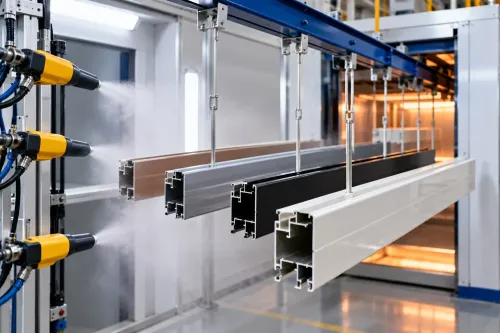
A verified PVDF coating for metal doors is a complete system: prepared substrate, approved pretreatment, specified primer, pigmented fluoropolymer colour coat, optional clear coat, controlled curing and final inspection. Omitting one layer can expose poor adhesion, early corrosion or uneven colour.
“Hyper durable PVDF coating” proves nothing by itself. Request the exact resin family, coat structure, dry-film thickness, primer, cure window, approved applicator or process route, warranty exclusions and evidence against the specified classification.
| Classification | What it means | What it does not mean |
|---|---|---|
| AAMA 2604 | High-performance architectural coating classification | Not interchangeable with AAMA 2605 |
| AAMA 2605 | More demanding high-performance classification | Not proof that every colour weathers identically |
| “PVDF” | Fluoropolymer wording | Not proof of either classification |
Specify UV colour retention separately from chalking, gloss loss, adhesion, abrasion, impact and chemical resistance. A coating can retain colour yet scratch, lose gloss or fail cross-cut adhesion.
Ask for the laboratory report and tested panel construction, pretreatment, dry-film thickness, scribe method, exposure cycle or irradiance, duration and acceptance limits.
ASTM B117 indicates salt-spray corrosion behaviour, ASTM D3359 cross-cut adhesion, ASTM D2244 colour difference and ASTM D4587 accelerated weathering; none predicts every field failure, and no test-hour figure converts directly into years in Mumbai.
Special anodizing versus PVDF: which finish suits the door’s job?
A documented PVDF system suits exposed external doors and large skins when ultraviolet colour retention matters most. Anodizing forms an integrated aluminium-oxide finish, so it cannot delaminate like paint, but its narrower colour range exposes alloy and substrate variation and makes replacement-part matching difficult.
| Aspect | Anodizing | PVDF |
|---|---|---|
| Corrosion resistance | Strong when sealed; cut edges and galvanic contacts remain risks | Strong with correct pretreatment and edge control |
| Colour and chalking | Narrower range; alloy variation shows; colour and gloss can shift | Broader colours, gloss and effects; better weathering and chalk control |
| Scratch and abrasion | Hard surface, but not scratch-proof | Less surface hardness; sharp tools, abrasion and cleaners damage it |
| Impact damage | Dents and marks expose or distort aluminium appearance | Impact can chip or dent the film; repairs may mismatch colour or gloss |
| Texture | Metallic and limited architectural effects | Smooth, textured and wood-effect options |
| Repair and maintenance | Local matching is difficult; wash with pH-neutral detergent | Controlled recoating is more practical; clean gently and repair visibly |
These special anodizing and PVDF coating benefits depend on process control, not labels. Consider anodizing for a controlled aluminium scheme after approving a representative sample; use either finish for sheltered entrances. Specify hardness, impact and cleaning controls for high-traffic interiors, chemical-resistance evidence for hospitals, and coordinated samples for hotels.
Do not pay for PVDF coating for metal doors when a low-cost interior door lacks controlled pretreatment, thickness, curing and handling.
Super-durable powder coating offers repeated-production colour range with less weathering control; wet-spray paint suits one-off work but demands tighter environmental control and leaves more repair and evidence questions.
How to control fabrication, coating stages and supplier evidence
Plan the finish before fabrication: decide whether cutting, punching, drilling, bending, welding, assembly and hardware installation occur before or after coating. Post-coating cuts expose bare metal; damage concentrates at edges, mitres, hinges, lock cut-outs, sealant joints and gasket contact areas.
For special anodizing in Mumbai, fabricate first wherever possible; for PVDF, protect finished faces and define edge repairs. A door manufacturer coating supplier, including AMECO World of Coatings, deserves approval for documented process control and system fit, not a product name.
| Stage | Anodizing | PVDF |
|---|---|---|
| Process | Bath preparation, colouring, rinsing, sealing | Pretreatment, primer, colour coat, clear coat, curing |
| Evidence | Sealing record and inspection report | Curing record and inspection report |
| Typical risk | Alloy variation and exposed cuts | Contamination, under-cure and excessive thickness |
Use this procurement checklist:
- Record substrate and alloy, door location, exposure, colour code, gloss level, finish class, film thickness and pretreatment description.
- Require the batch number, approved sample, inspection points, test reports, warranty terms, repair method, cleaning instructions, packaging and responsibility after delivery.
- Inspect flat faces, edges, holes, welds and concealed faces before acceptance.
A supplier that cannot produce sealing or curing records cannot prove the specified system was made.
Related products
 | Products as well as projects exposed to very harsh climatic and industrial conditions require extremely durable range of coatings. View product → |
 | Ameco powder coating effect on metals is a safer and better alternative to conventional acrylic and polymer wet spray painting. View product → |
Maintenance, transport and repair rules that protect the finished door
Follow supplier instructions for cleaning and inspection; increase checks at exposed coastal or polluted Mumbai sites, not on a universal interval.
1. Remove salt and industrial deposits with clean water and non-abrasive, pH-neutral detergent. Prohibit steel wool, abrasive pads, strong acids, strong alkalis, solvents and unapproved chemicals. Use only a tested stain or graffiti method, trialled before use.
2. During transport and installation, use removable protective film, edge guards and separators; dry-stack doors. Remove film on the supplier’s schedule so heat cannot bake adhesive residue onto the finish.
3. Expect PVDF touch-up to remain visible and anodized touch-up rarely to match. Use replaceable skins or panels for prominent damage.
Anodizing is wrong for broad-colour or frequent-repair requirements. A hyper durable PVDF coating is wrong when pretreatment, thickness, curing or handling are uncontrolled. The door manufacturer coating specification must test the whole project: sample approval, minimum-batch coordination, colour matching, pretreatment control, inspection, packaging, rework and lead time.
Frequently asked questions
What does special anodizing mean for an aluminium door?
It must name a process beyond basic clear anodizing, such as electrolytic or two-step colouring, integral colouring, hard anodizing, tighter film-thickness control or specified sealing.
How do Mumbai conditions affect the choice between anodizing and PVDF?
Humidity, monsoon water, urban pollutants, coastal salt and the door’s construction affect corrosion exposure, drainage, cleaning access and finish selection.
What does a verified hyper durable PVDF coating prove?
It proves that the specified coating system meets a named durability classification or test requirement; it does not guarantee identical performance on every substrate, edge or installation.
What evidence should a door manufacturer request from a coating supplier?
Request the product data sheet, colour reference, coating-system details, pretreatment specification, batch number, application records and inspection or test results.
Related products
 | Wood Effect on Metals Wood Effect Powder Coating on Aluminium Section ₹60 Ameco powder coating effect on metals is a safer and better alternative to conventional acrylic and polymer wet spray painting. View product → |
 | Coloral Wood Effect Finish Powder Coatings ₹60 We believe nature is supreme! Our high fidelity coatings of wooden patterns & figures on metal surfaces stand testimony to our belief. View product → |
 | Wood Grain Powder Coating Wood Grain Powder Coating on Baffle Ceiling ₹60 We believe nature is supreme! Our high fidelity coatings of wooden patterns & figures on metal surfaces stand testimony to our belief. View product → |
 | Wood Finish Coating Sublimation Machine For Alumin Wood Finish Coating Sublimation Machine For Aluminium and Metal Doors Wood Finish Coating Sublimation Machine For Aluminium and Metal Doors View product → |
Keywords