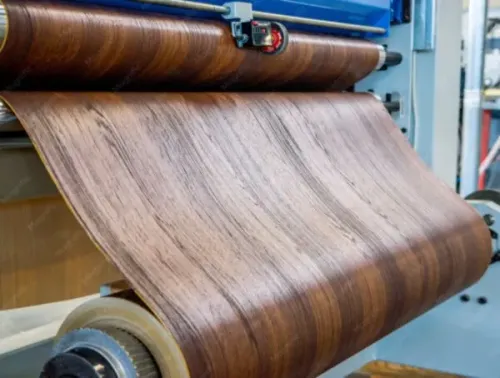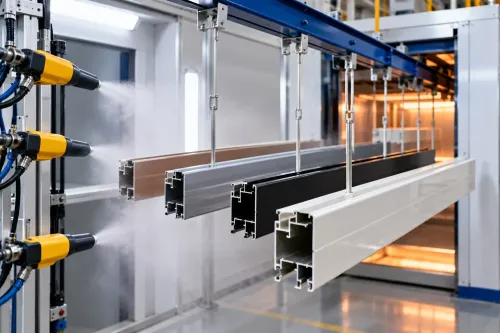
The purchase only pays off when your aluminium profiles, coating system, oven capacity and order volume fit the machine’s real working limits. By checking the process, specifications, operating costs, coastal-storage risks and supplier trial results, you can decide whether to buy, outsource or delay the investment.
Key takeaways
- Test adhesion and contamination before loading aluminium into the sublimation machine.
- Match oven size and transfer method to your largest door profile.
- Calculate payback from throughput, labour time and rejected panels.
- Require a full supplier trial using your aluminium, base coat and design film.
What the sublimation process requires before the machine starts
A sublimation machine transfers a pattern; it does not repair weak adhesion, contamination or an unsuitable base coat. Prepare and verify the aluminium before loading the wood finish coating equipment.
1. Degrease the aluminium, rinse it thoroughly, apply the specified conversion treatment, rinse again and dry completely. Record chemical concentrations, bath temperatures, rinse quality and drying conditions. Dust, humidity, condensation and salt contamination in Mumbai can cause pinholes, corrosion or later adhesion failure.
2. Apply a compatible primer or base powder at the approved film thickness, colour and gloss. Cure it to the specified schedule, then cool and inspect the surface. A powder intended for ordinary architectural use is not automatically suitable for sublimation; its melt flow, cure response and resistance to transfer heat must be qualified.
3. Wrap the cured profile with the selected printed transfer film. Check grain direction, overlap and film tension, then seal every opening with the specified tape or sealing method. Use clean, dry reusable vacuum bags, membranes and hoses; damaged materials can admit air or create ghosting.
4. Place the wrapped profile under vacuum or membrane pressure and heat it until the ink sublimes into the cured powder film. Control temperature uniformity, dwell time and pressure rather than relying on the machine display alone.
5. Cool the part before releasing pressure and stripping the film. Approve the powder, film, ink and cure schedule as one system, then retain the transfer pattern, pretreatment records and cured-panel adhesion results. A successful-looking pattern cannot excuse failed pretreatment or poor adhesion.
Which machine size and transfer method match your aluminium doors
A machine suits your doors only when its usable chamber and transfer method fit the actual profiles. A profile sublimation line or vacuum/membrane system is usually the right starting point; a generic flat heat press suits flat panels, not three-dimensional door sections.
| Method | Best fit | Main limitation |
|---|---|---|
| Profile sublimation line | Loose, long aluminium profiles processed before assembly | A profile bundle may fit while an assembled frame does not |
| Vacuum or membrane system | Grooves, recesses and several faces; pressure pulls film into the section | Sharp corners, deep cavities, venting paths and abrupt changes can bridge or transfer incompletely |
| Flat heat press | Flat panels or simple, accessible faces | It cannot apply uniform contact through complex profile geometry |
Measure usable internal length, height and width, door clearance, fixture space and maximum profile bundle. Do not rely on outside dimensions. A sublimation machine for aluminium doors sized for loose profiles cannot be assumed to finish an assembled door: the frame consumes space, blocks faces and creates shadows around joints and hardware.
Request these figures for any wood finish coating machine in Mumbai:
- Maximum workpiece length and profile cross-section
- Chamber dimensions, heating temperature and dwell time
- Vacuum level, membrane type and loading arrangement
- Power load and compressed-air requirement
- Capacity for loose profiles, long sections, panels, assembled frames and mixed-size batches without tooling changes
Run the supplier trial on your longest, deepest and most difficult section, not a flat sample. If film cannot vent or reach an internal corner, the machine’s quoted capacity is irrelevant.
When the Mumbai investment earns back its time and capital
A wood finish coating sublimation machine in Mumbai earns back its capital only when the oven stays loaded with repeat work. Calculate usable output from the complete production cycle, not the advertised vacuum or press time.
1. Time one real batch: film wrapping, loading, heating, cooling, stripping, inspection, colour changes, cleaning and rework. Record the operator count for each stage. The oven is usually the bottleneck, so request a trial using your longest and most complex profile.
Usable pieces per shift = actual profiles loaded per cycle × completed cycles per shift × acceptable yield.
2. Build the cost per accepted piece. Include printed film, base powder, sealing tape, electricity, compressed air, maintenance, operator training, rejected parts, storage and working capital tied up in consumables and unfinished stock. Add installation and idle-capital costs; a cheap cycle becomes expensive when orders stop.
3. Buying is strongest when repeat demand keeps the oven full, designs stay within a controlled range, outsourced lead times cost sales and consistent colour control matters. Outsourcing is safer when orders are sporadic, designs change frequently, or you lack pretreatment, powder-coating and inspection expertise.
4. Ask AMECO World of Coatings for a documented trial covering process compatibility, cycle data, utility consumption, defect rate and output on your profiles before comparing wood finish coating equipment.
Do not approve a wood finish coating equipment purchase from catalogue capacity alone. Accept the investment only when tested output, rework and total cost beat your outsourcing price.
Related products
 | Wood Finish Coating Sublimation Machine For Alumin Wood Finish Coating Sublimation Machine For Aluminium and Metal Doors Wood Finish Coating Sublimation Machine For Aluminium and Metal Doors View product → |
 | Wood Effect Finish Sublimation Film Wood Effect Finish Sublimation Film Wood Effect Finish Sublimation Film View product → |
How to protect appearance and durability after transfer
Transfer quality becomes a durable door finish only when the film stays aligned and immobile throughout heating. A metal door sublimation machine cannot correct poor wrapping, weak powder adhesion or inaccessible surfaces.
1. Wrap profiles before assembly whenever possible. Align the printed grain with the intended direction, keep tension even, and cover corners, joints, screw channels, drainage slots and internal faces. Seal every edge; movement during heating creates ghosting or double images.
2. Inspect every batch for wrinkles, trapped air, pinholes, grain misregistration, powder contamination and incomplete transfer in recesses. Compare profiles from different oven positions for uneven colour, and check corners, cut ends and concealed faces before assembly.
3. Approve colour with retained reference panels made using the production powder, film lot, cure history and machine settings. Base-powder shade and gloss, film lot, cure history and viewing angle all change the result, so a screen image or paper print is not approval evidence.
4. For exterior doors, name AAMA 2603, AAMA 2604, AAMA 2605 or the applicable Qualicoat class in the specification. “Wood finish” describes appearance, not durability. Protect finished profiles, cut edges and hardware from scratches during later assembly, and control joint alignment and sealant coverage.
What supplier trial proves a machine is worth buying
A machine is worth buying only after a documented production trial succeeds on your actual products. Whether it is a wood finish coating machine in Mumbai, a sublimation machine for aluminium doors or a metal door sublimation machine, a catalogue demonstration proves very little.
Require the supplier to process:
- Your aluminium alloy, longest profile, most difficult section, chosen base powder and intended transfer film.
- Cure readings, chamber temperature uniformity, transfer temperature, dwell time, vacuum level, loading time, film usage, cooling time, operator count, defects and pieces per shift.
- Grain registration on corners, cavities, screw channels and both visible faces. Check for wrinkles, trapped air, pinholes, incomplete transfer and colour differences between oven positions.
- Adhesion and the durability properties specified by the selected AAMA specification or Qualicoat class. A transferred pattern on one demonstration panel is not acceptance evidence.
Ask for utility consumption, power load, compressed-air quality, maintenance intervals, spare-parts availability, training, chamber clear dimensions and a written guarantee for mixed-size batches.
Buy only when the trial meets the approved reference panel, capacity calculation and durability requirement with acceptable rework.
| Decision | Buy the machine | Outsource production |
|---|---|---|
| Trial result | Passes all appearance and durability tests | Fails any critical requirement |
| Capacity | Oven stays loaded at planned volume | Oven remains idle |
| Control burden | Staff and records are manageable | Process control costs more than in-house value |
| Risk | Repeat demand justifies capital | Orders are sporadic or designs change frequently |
Frequently asked questions
What must you check before sublimating aluminium doors?
Verify surface cleanliness, base-coat adhesion, coating cure and profile condition before transferring the wood-effect pattern. Sublimation will not correct weak adhesion or contamination.
How do you choose a sublimation machine for aluminium doors?
Size the chamber, heating system and transfer method around your longest, widest and heaviest profiles, plus the production volume you need to process.
When does a wood finish sublimation machine earn back its cost in Mumbai?
Compare the machine’s purchase and operating costs with saved labour, faster throughput, lower rework and the volume of aluminium doors you can finish.
What should a supplier trial include before purchase?
Run your aluminium profiles, base coat, wood-effect film and production settings through the proposed equipment, then inspect colour, transfer coverage, adhesion and durability.
Related products
 | Wood Grain Powder Coating Wood Grain Powder Coating on Baffle Ceiling ₹60 We believe nature is supreme! Our high fidelity coatings of wooden patterns & figures on metal surfaces stand testimony to our belief. View product → |
 | Coloral Wood Effect Finish Powder Coatings ₹60 We believe nature is supreme! Our high fidelity coatings of wooden patterns & figures on metal surfaces stand testimony to our belief. View product → |
 | Vacuum Sublimation Machine For Aluminium And Metal Vacuum Sublimation Machine For Aluminium And Metal Doors Vacuum Sublimation Machine For Aluminium And Metal Doors View product → |
 | Wood Effect on Metals Wood Effect Powder Coating on Aluminium Section ₹60 Ameco powder coating effect on metals is a safer and better alternative to conventional acrylic and polymer wet spray painting. View product → |
Keywords