“SPL anodizing” does not identify a recognised coating class or prove that a wood-effect finish will adhere to the aluminium. You need to establish what the supplier means, define the layer sequence, qualify the complete system on representative façade sections, and match the test evidence to the project specification before approving production.
Key takeaways
- Treat SPL anodizing as a proprietary process until the supplier defines it.
- Run a compatibility trial on the complete layer sequence before production.
- Test actual façade components for weathering, adhesion and cleaning exposure.
- Approve only after reviewing documents and inspecting full-size samples.
Define SPL Anodizing Before Comparing It with a Wood-Effect Finish
“SPL anodizing” does not identify a recognised anodizing standard by itself. It is usually a supplier’s proprietary process name or a project shorthand, so it cannot be treated as equivalent to QUALANOD or to a coating class such as AAMA 2604 or AAMA 2605 without supporting documents.
Conventional anodizing converts the aluminium surface into a controlled oxide layer. A wood-effect sublimation finish uses a different system: printed pigments transfer from a film into a cured, usually polyester, powder-coated basecoat. The polymer layer accepts the sublimation inks; standard anodizing does not. Direct transfer onto finished anodizing should therefore not be assumed.
For spl anodizing with coloral wood effect finish for façade manufacturers, place SPL anodizing in the specification only after the layer sequence is clear:
- Ask the supplier to define SPL, including aluminium alloy and temper, cleaning, etching, anodizing bath controls, rinsing, sealing, drying and masking.
- Identify whether the anodized layer is the exposed finish, a visual base beneath another coating, or a separate component finish.
- Confirm the wood-effect system’s basecoat, cure state, film temperature, pressure and dwell time.
- Reject any description that calls a sublimated transfer “anodizing” unless the technical documentation explicitly defines a combined or post-anodizing process.
In practice, an SPL anodizing wood effect finish usually means an anodic-look powder basecoat or a separately finished component, not sublimation directly over anodized aluminium. Treat the proposed layer structure as unapproved until a production-representative compatibility trial confirms it.
Use a Compatibility Trial to Prove the Layer Sequence
Determine compatibility by running a documented trial on production-representative aluminium sections, using the exact anodizing, basecoat and transfer sequence proposed for the façade. Do not assume that a Coloral wood effect coating will bond to finished anodized aluminium: sublimation normally diffuses pigments into a cured polyester powder layer, not into an oxide surface.
1. Record the aluminium alloy and temper, masking plan, and proposed layer structure. Ask whether “SPL anodizing” is a defined process or a supplier’s project name, then obtain its preparation, bath-control, rinsing, sealing and drying requirements.
2. Anodize representative sections using the proposed bath conditions and sealing step. Include flat faces, exposed edges and areas that will remain masked, because residue or a damaged seal can affect adhesion.
3. Apply the specified anodic-look powder basecoat, if the system uses one, and cure it at the supplier’s stated film temperature and dwell time. Do not substitute a conventional anodized surface without written confirmation that direct transfer is intended.
4. Apply the wood-effect film at the specified temperature, pressure and dwell time. Produce full-size sections with joints, corners and formed areas rather than relying on a small flat coupon.
5. Inspect colour, grain registration, gloss, pinholes and edge coverage, then test adhesion before and after environmental exposure. Record failures separately for the oxide, powder layer and transfer layer.
Approve the SPL anodizing wood effect finish only after the supplier identifies every layer and process step in writing and provides a warranty covering that sequence. A fresh flat panel proves appearance, not façade compatibility.
Qualify the Finish on the Actual Façade Components
Coat the profiles at the same stage used for the façade: normally after extrusion, pretreatment and curing, but before cutting, drilling and assembly. If the project coats fabricated frames or panels instead, trial those completed components; changing the production sequence can expose uncoated edges, damaged film or altered grain alignment.
| Trial sample | What it must represent | Failure it can reveal |
|---|---|---|
| Flat coupon | Basecoat, transfer film, cure and colour on a smooth section | Colour, gloss and print-registration problems only |
| Full extrusion | The actual alloy, temper, wall thickness, grooves and recesses | Pinholes, poor coverage, grain variation and adhesion loss |
| Fabricated component | Cut ends, mitres, corners, joints, drilled holes, formed areas and deep recesses | Edge exposure, handling damage and visible mismatch after assembly |
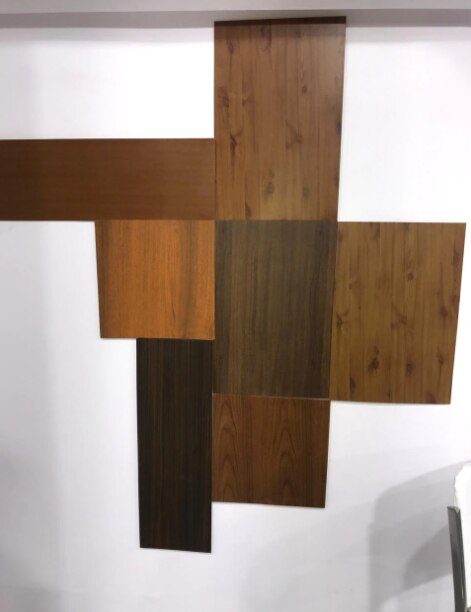
Include every façade coating option under consideration in the same production-representative comparison, including the proposed wood finish façade coating. Mark the viewing face and grain direction, then inspect profiles from normal viewing distance under daylight and oblique light.
The approval sample must also include adjacent profiles and panels from separate coating batches. Check gloss drift, grain registration and colour consistency across the joint; a perfect single face proves little. Record masking lines, sealing areas and any surfaces that must remain anodized.
Do not approve a direct transfer onto conventional anodizing unless the supplier documents that exact layer sequence and demonstrates adhesion after fabrication.
Specify Tests for Weathering, Adhesion and Cleaning Exposure
Do not accept a flat appearance panel as evidence that a wood finish façade coating will survive outdoors. Request results for the complete SPL anodizing and Coloral layer sequence, tested on the specified aluminium alloy, pretreatment, primer or basecoat, transfer film, clear coat, and dry-film thickness.
| Test area | Evidence to request | Failure to reject |
|---|---|---|
| Weathering | Accelerated exposure and exterior durability classification against the selected AAMA 2603, 2604 or 2605 requirement, or the applicable QUALICOAT specification; include colour change, gloss retention, chalking, blistering and film defects | Grain fading, gloss drift, chalking, blisters or different weathering on profiles and panels |
| Adhesion | Cross-cut adhesion results to ASTM D3359 or ISO 2409, recorded before and after weathering; include edges, corners, cut ends and formed areas | Peeling, flaking or loss of adhesion at edges and recesses |
| Cleaning exposure | A written cleaning protocol naming the detergent, concentration, water temperature, contact time, number of cycles and wiping method, followed by colour, gloss and surface inspection | Staining, pigment transfer, gloss change, swelling or print damage |
Request the laboratory report, not only a pass statement. It must identify specimen dimensions, exposure duration, test dates, instruments, readings and photographs before and after testing.
- Test the actual façade geometry, including joints, deep recesses and corners.
- Record the approved colour and grain tolerances beside the weathering results.
- Ask whether the cleaning test represents the site’s planned detergents, pressure and frequency.
- Reject evidence that covers only the anodized layer or only the decorative face; both layers must pass as one system.
This evidence lets you compare façade coating options on service performance rather than on a freshly produced sample.
Make the Approval Decision from Documents and Full-Size Samples
Do not approve “SPL anodizing” from its name alone. The purchase specification must state whether it is an anodized substrate, an anodic-look powder basecoat, or a proprietary process, because SPL is not itself equivalent to QUALANOD or AAMA 2604/2605.
For spl anodizing with coloral wood effect finish for façade manufacturers, define the complete layer sequence and responsibility for each process step.
1. Name the aluminium alloy and temper, pretreatment, anodizing bath controls, sealing, rinsing, drying, masking, primer or basecoat, transfer film, clear coat, cure schedule, nominal dry-film thickness and exterior-durability classification.
2. Require reports for adhesion, colour and appearance after environmental exposure, plus inspection of cut edges, bends, formed areas, seams and pattern transitions.
3. Approve physical control samples showing grain direction, repeat length, permitted shade tolerance, viewing distance and lighting. A digital image, one colour-meter reading or a flat panel is not enough.
4. Require a written warranty naming every layer, supplier, process limit, repair method and excluded condition. Reject substitutions without written approval.
The final package should contain the signed specification, process records, test reports, approved full-size representative sections and photographs of fabrication details. If AMECO World of Coatings is the system supplier, request these documents for the exact alloy, profile and finish combination rather than a generic brochure.
Select the finish only when the documents and samples match the production component. A colour match without proven edge adhesion or formed-area performance is not façade approval.
Frequently asked questions
What is SPL anodizing, and is it an anodizing standard?
SPL anodizing is not a recognised anodizing standard by itself. Treat it as a supplier process name or project shorthand until the supplier provides process details and supporting documents.
How can you prove compatibility between SPL anodizing and a Coloral wood-effect finish?
Run a compatibility trial using the proposed substrate preparation, SPL anodizing, Coloral wood-effect coating and any clear coat in the exact layer sequence planned for production.
Which façade components should you use for qualification?
Qualify the finish on the actual aluminium profiles, panels, trims, joints, corners, fastener areas and formed components specified for the façade.
Which tests should a façade manufacturer specify?
Specify weathering, adhesion and cleaning-exposure tests, with test panels and acceptance limits agreed before production approval.
What evidence should support final finish approval?
Review the SPL process definition, coating technical data, batch records, test reports and full-size samples before approving the façade finish.
Keywords